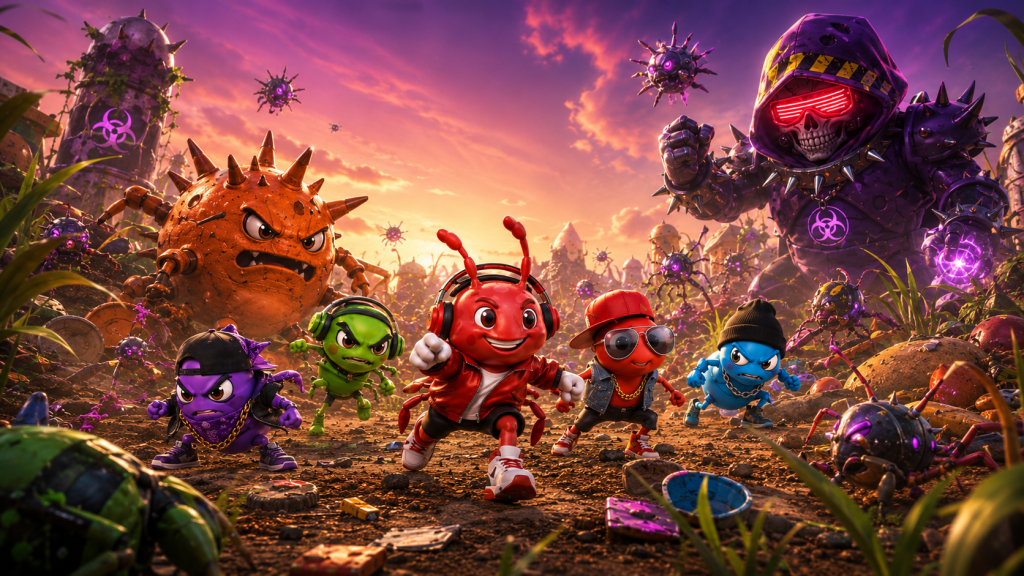
1. Game Overview
Chiggas: Survival of the Mitiest is a survival strategy game where players lead a swarm of tiny Chiggas through a chaotic microscopic turf war. The goal is to recruit units, claim turfs, fight rival parasite gangs, collect power-ups, and survive increasingly dangerous boss battles. The game combines: Survival gameplay Turf-control strategy Recruitable swarm units Rival enemy gangs Boss fights Weapons and power-ups Stage-by-stage progression Players begin on smaller skin battlefields and eventually face larger, stranger, and more chaotic survival arenas.
The main goal of Chiggas: Survival of the Mitiest is to survive each stage by growing your swarm, taking control of turfs, and defeating the boss tied to that battlefield. Each stage adds more pressure through stronger enemies, more turfs, and more dangerous boss mechanics. Players should focus on three main objectives: Recruit Chiggas to grow their swarm. Claim turfs before rival gangs take control. Survive boss fights using movement, weapons, and power-ups. The deeper you get into the game, the more important it becomes to balance expansion, combat, and survival.
Players should learn about enemies, bosses, stages, and power-ups because these four systems shape every run in Chiggas: Survival of the Mitiest. Stages decide where the battle happens, enemies create constant pressure, bosses test survival skills, and power-ups give players the tools needed to stay alive. Game System Why It Matters Stages Control the battlefield size, turf count, and boss encounter Enemies Pressure the player and compete for control Bosses Create major survival challenges at key moments Power-Ups Help players move faster, attack harder, and command the swarm Understanding how these systems connect helps players survive longer and make smarter decisions during each stage.
2. Enemies
No. Not all Chiggas are enemies. Chillin Chiggas are recruitable Chigga units scattered across the battlefield. Players can gather them to grow their swarm and improve their chances of surviving enemy attacks, rival gangs, and boss fights. Recruitable Chiggas are important because they help players: Build a stronger swarm Capture more turfs Apply pressure during fights Use Charge more effectively Survive longer against bosses A larger swarm gives players more options, but it also requires smarter control.
The Green Clover Mite Gang is different from the Blue House Mite Gang because it prefers to recruit a mob before expanding. While the Blue House Mite Gang spreads quickly, the Green Clover Mite Gang becomes dangerous by building numbers first. Enemy Gang Main Threat Blue House Mite Gang Expands quickly Green Clover Mite Gang Builds a mob before expanding Players should not wait too long to deal with the Green Clover Mite Gang. If ignored, their growing mob can become harder to stop.
Wild Parasites are hostile creatures that roam the skin and attack during survival stages. They are dangerous because they can interrupt your movement and pressure your swarm, but they can also become useful because they are tied to the game’s survival and strength-building systems. Wild Parasites are best understood as: Roaming enemies Immediate combat threats Potential strength-building opportunities Battlefield pressure tools Players should not ignore Wild Parasites, but they should also learn when to use Munch and other tools to turn danger into survival momentum.
The Blue House Mite Gang is a rival crew that likes to expand quickly across the battlefield. This makes them a turf-control threat because they can take space before the player has time to build a strong swarm. Players should watch the Blue House Mite Gang early because fast expansion can create problems later in a stage. Best response: Claim nearby turfs early. Do not let them spread uncontested. Recruit Chiggas before engaging too deeply. Use weapons or Charge if they start gaining too much control. Fast enemies are easier to manage early than after they dominate the map.
The enemies in Chiggas: Survival of the Mitiest include wild parasites, rival mite gangs, and boss creatures. Each enemy type pressures the player differently, so survival depends on knowing which threats to fight, avoid, or use to your advantage. Main enemy types include: Wild Parasites Blue House Mite Gang Green Clover Mite Gang Purple Scabies Gang Orange Itch Mite Gang Stage bosses Some enemies roam and attack, while others compete for turf or build up large groups before expanding.
The Orange Itch Mite Gang is dangerous because it is both strong and numerous. This crew does not rely only on speed or aggression. Instead, it brings heavy pressure through force and numbers. Players should be careful when fighting the Orange Itch Mite Gang because a weak swarm can be overwhelmed quickly. Good counters include: Building your swarm before engaging Using the Rifle or Pistol for ranged support Saving Charge for crowded fights Using Speed Boost to avoid being trapped Using Munch strategically when strength matters more than numbers The Orange Itch Mite Gang is a sign that players need to manage combat more carefully.
The Purple Scabies Gang is one of the most aggressive rival crews in Chiggas: Survival of the Mitiest. This gang is highly hostile and always wants what the player has, which makes it especially dangerous when the player is trying to expand or hold valuable turf. Players should treat the Purple Scabies Gang as an active threat, not a background enemy. Recommended response: Keep moving. Avoid letting them surround you. Use Charge when your swarm is ready. Use ranged weapons to reduce pressure. Do not leave key turfs undefended. The Purple Scabies Gang can punish players who expand without preparing for a fight.
3. Bosses
Players can beat the Flea King by staying mobile, watching for belly flop attacks, and using the first stage to build a strong enough swarm before the boss fight begins. The Flea King is weaker than later bosses, but it can still punish players who stand still or rush in without support. Basic Flea King strategy: Recruit Chiggas early. Claim the 5 Forearm turfs. Avoid belly flop attacks. Use ranged weapons if available. Attack when the boss is vulnerable. The Flea King is the first major test of movement and swarm control.
Players should survive the Mite Overlord by avoiding gooey spit, keeping distance during spin attacks, and using weapons or Charge at the right moment. The Mite Overlord is more dangerous than earlier bosses because it can pressure the player with multiple attack types. A good Mite Overlord strategy includes: Keep moving during spit attacks. Stay away when spin attacks begin. Use ranged weapons when distance is safer. Use Charge after the boss commits to an attack. Avoid getting trapped near enemy groups. The Mite Overlord is a boss where timing matters more than aggression.
The Roach Czar is the final boss because it appears in Stage 6: The Grass Lawn and shifts the game into pure survival mayhem. Unlike earlier bosses that are tied closely to turf control, the Roach Czar is built to test whether the player can survive the game’s most chaotic encounter. Players should expect the final fight to demand: Fast reactions Smart movement Careful power-up timing Strong swarm management Survival-first decision making Against the Roach Czar, staying alive matters more than playing aggressively.
The bosses in Chiggas: Survival of the Mitiest are oversized stage-ending threats that test the player’s survival skills. Each boss appears in a specific stage and has a different style of attack or pressure. Boss Stage Main Threat Flea King The Forearm Belly flop attacks Tick Tyrant The Shin Teleports from danger Mite Overlord The Back Gooey spit and spin attacks Lice Lord The Foot Can infect the skin Tick Twins The Hound Split pressure on turfs and player Roach Czar Grass Lawn Final survival mayhem Bosses become more dangerous as the player progresses, so every stage requires better timing and stronger survival decisions.
The Tick Twins are difficult because they split the player’s attention between two threats. One Tick Twin wants your turfs, while the other wants you. This creates a dual-pressure boss fight where players cannot focus on only one objective. The Tick Twins are dangerous because they attack two priorities: Tick Twins Pressure What It Means Turf pressure Your controlled areas are threatened Player pressure You are directly hunted or attacked Players should use Speed Boost, Charge, and ranged weapons carefully during this fight. Trying to handle both twins without preparation can quickly overwhelm the swarm.
The Tick Tyrant is tricky because it can teleport away from danger. This makes the fight less predictable than the Flea King battle and forces players to keep moving, reposition, and avoid wasting attacks. Players should fight the Tick Tyrant with patience. Useful tactics include: Avoid chasing blindly. Keep your swarm nearby. Use ranged attacks when possible. Save movement boosts for repositioning. Watch where the boss appears after teleporting. The Tick Tyrant teaches players that not every boss can be handled by rushing forward.
Players should not ignore the Lice Lord because it can infect the skin if not dealt with quickly. While the Lice Lord may not feel as overwhelming as some other bosses, letting it stay active too long can make the stage harder to control. The Lice Lord is dangerous because it creates indirect pressure. Instead of only attacking the player, it can worsen the battlefield if the player delays the fight. Best approach: Prepare before the boss becomes a major problem. Use ranged weapons to apply steady damage. Keep turfs under control. Avoid getting distracted by smaller enemies for too long. Finish the boss before infection pressure grows.
4. Power-Ups and Weapons
Players can survive longer by building a strong swarm early, using power-ups at the right time, and avoiding unnecessary fights. Survival depends on controlling the battlefield without getting trapped by enemies or bosses. Key survival tips: Keep moving instead of standing still. Recruit before major fights. Use Speed Boost to escape danger. Use ranged weapons when close combat is risky. Save Charge for crowded battles or boss openings. Use Munch when strength matters more than keeping everything. Watch for boss attack patterns before committing. Longer survival comes from smart timing, not constant aggression.
Players should focus on different priorities depending on the stage situation. Early in a stage, recruiting and turf control usually matter most. As enemy pressure grows, players need to manage threats. Near the end of a stage, boss preparation becomes the priority. A simple priority order is: Recruit Chiggas to build a swarm. Claim turfs before rival gangs spread. Control enemies so they do not overwhelm the map. Collect power-ups before major fights. Prepare for the boss once the stage escalates. The best players know when to switch priorities instead of doing the same thing the whole run.
harge is a soldier swarm attack command. It lets players send their Chigga swarm into an aggressive attack, which can help overwhelm enemies, pressure bosses, or defend against rival gangs. Charge is strongest when: The player has recruited enough Chiggas. Enemies are grouped together. A boss is vulnerable. A rival gang is threatening turf. The player needs a sudden burst of pressure. Players should avoid wasting Charge when the swarm is too small or scattered.
Munch helps the player build strength through sacrifice. It is one of the stranger but more strategic tools in Chiggas: Survival of the Mitiest because it asks players to decide when strength is more valuable than keeping every unit or opportunity intact. Munch can be useful when: The player needs more strength. Enemy pressure is increasing. A boss fight is coming. Survival matters more than numbers. A risky tradeoff could help the run continue. Munch should be used carefully because survival in Chiggas is often about knowing what to keep, what to sacrifice, and when to grow stronger.
An advanced strategy for tougher stages is to control pressure before it becomes impossible to manage. In later stages, enemies, turfs, and bosses overlap more often, so players should think ahead instead of reacting too late. Advanced players should: Identify the most dangerous rival gang early. Stop fast-expanding enemies before they spread. Keep the swarm close before boss fights. Use Charge only when it can change the fight. Save Speed Boost for escape, not convenience. Use ranged weapons to soften bosses before committing. Avoid chasing enemies into bad positions. The best strategy is to reduce future danger before it becomes immediate danger.
The best beginner strategy is to recruit early, claim nearby turfs, keep moving, and avoid fighting too many enemies at once. New players should focus on learning the survival loop before trying to play aggressively. Beginner strategy checklist: Recruit Chillin Chiggas early. Claim easy turfs first. Avoid getting surrounded. Use weapons before enemies crowd the screen. Save Charge for serious threats. Watch boss attack patterns. Use Speed Boost to escape danger. Players who build momentum early usually survive longer.
The Pistol and Rifle are both ranged weapons, but they serve slightly different combat roles. The Pistol gives players ranged attack power, while the Rifle provides automatic ranged firepower. Weapon Best Use Pistol Safer single-target ranged attacks Rifle Automatic pressure against enemies and bosses Players should use ranged weapons when direct contact is too risky. They are especially helpful when fighting aggressive gangs, crowded enemy groups, or bosses that punish close-range movement.
Chiggas: Survival of the Mitiest includes several power-ups and skills that help players survive enemies, bosses, and larger stage battles. Power-Up / Weapon Effect Speed Boost Temporarily increases movement speed Pistol Gives the player a ranged weapon Rifle Adds automatic ranged firepower Charge Sends the soldier swarm into attack mode Munch Builds strength through sacrifice These tools help players move faster, fight safer, command their swarm, and survive dangerous moments.
Players should use Speed Boost when they need to escape danger, dodge boss attacks, reposition quickly, or avoid being surrounded. Speed Boost is especially useful during boss fights and crowded enemy encounters. Best moments to use Speed Boost: Dodging Flea King belly flops Repositioning against Tick Tyrant Escaping Mite Overlord spin attacks Avoiding Tick Twins pressure Surviving late-stage chaos Moving quickly between turfs Speed Boost is most valuable when used to prevent damage or escape a losing position.
Players can download Chiggas: Survival of the Mitiest through the official website, with platform options for Google Play and Steam Games. The game is built for players who want: A weird survival strategy game Turf-control gameplay Swarm-based combat Boss battles Power-ups and weapons Mobile or desktop play Players should visit the official download links on the Chiggas website to get the correct version for their platform.
The best power-ups for boss fights depend on the boss, but most players should rely on Speed Boost, ranged weapons, Charge, and Munch in different situations. Boss Fight Need Best Tool Dodging attacks Speed Boost Safer damage Pistol or Rifle Burst pressure Charge Strength building Munch A good boss fight strategy is to use Speed Boost for survival, weapons for steady damage, Charge when the boss is vulnerable, and Munch when building strength becomes necessary.
Turf control is important because it gives players more control over the battlefield and helps prevent rival gangs from spreading too quickly. Each stage has a different number of turfs, and claiming them is part of surviving long enough to reach the boss fight. Turf control helps players: Limit enemy expansion Build stage momentum Create safer movement zones Prepare for boss encounters Keep rival gangs under pressure Ignoring turfs can allow enemies to take over the battlefield before the player is ready.
5. Survival Stages
Chiggas: Survival of the Mitiest includes six survival stages. Each stage introduces a new battlefield, a different turf challenge, and a boss encounter. Stage Location Turfs Boss Stage 1 The Forearm 5 Flea King Stage 2 The Shin 8 Tick Tyrant Stage 3 The Back 12 Mite Overlord Stage 4 The Foot 15 Lice Lord Stage 5 The Hound 18 Tick Twins Stage 6 The Grass Lawn Final Stage Roach Czar
Stage 1: The Forearm is the first survival stage in Chiggas: Survival of the Mitiest. It takes place on a dry forearm skin battlefield and includes 5 turfs to claim before facing the Flea King. Stage 1 is important because it teaches players the basic survival loop: Move around the skin battlefield. Recruit Chillin Chiggas. Claim turfs. Watch for enemy pressure. Prepare for the first boss fight. The Forearm is the best stage for new players to learn how turf control and swarm survival work before moving into larger battles.
Stage 6: The Grass Lawn is the final stage in Chiggas: Survival of the Mitiest. Unlike earlier stages that focus heavily on turf control, the Grass Lawn is built around final-stage mayhem and survival against the Roach Czar. The Roach Czar is the final boss, and the goal is simple: stay alive. Players entering Stage 6 should be ready for: Faster survival pressure Less predictable battlefield chaos Final boss aggression Heavy reliance on power-ups High-risk movement decisions The Grass Lawn is where players prove they can survive the weirdest microscopic turf war to the end.
Stage 2: The Shin is harder than The Forearm because it increases the number of turfs from 5 to 8 and introduces the Tick Tyrant boss. The Shin takes place on a rough skin battlefield where players need to expand faster while staying alert for stronger enemy pressure. Compared to Stage 1, Stage 2 requires players to: Claim more turf Recruit more carefully React faster to enemy movement Prepare for a trickier boss fight Use power-ups more strategically The Tick Tyrant can teleport away from danger, which forces players to stay mobile and adjust their attacks.
Stage 5: The Hound is one of the hardest stages because it takes place in thick dog fur and includes 18 turfs plus the Tick Twins boss fight. The Tick Twins create split pressure: one targets your turfs while the other targets you directly. This stage is difficult because players must manage two survival problems at once: Threat What It Does Turf pressure One Tick Twin threatens your controlled areas Player pressure The other Tick Twin focuses on chasing or damaging you To survive The Hound, players need strong movement, a large swarm, and smart use of Charge, weapons, and Speed Boosts.
Stage 3: The Back gives players a larger battlefield with 12 turfs and a more dangerous boss: the Mite Overlord. This stage begins to feel more like a mid-game survival challenge because the player has more space to control and more threats to manage. Players should expect: A wider battlefield More turf pressure Stronger enemy groups More need for weapons and power-ups A boss with gooey spit and spin attacks The Mite Overlord can punish players who stand still too long, so movement and timing become more important in this stage.
Stage 4: The Foot is dangerous because it takes place on a dirty, calloused foot battlefield with 15 turfs and the Lice Lord boss. While the Lice Lord may not seem like the most intimidating boss at first, it can infect the skin if players ignore it for too long. Players should treat Stage 4 as a pressure-management stage. The goal is not only to claim turfs but also to prevent the battlefield from getting out of control. Key threats include: More turfs to defend Stronger enemy pressure Infection risk from Lice Lord Reduced room for mistakes Greater need for ranged weapons and swarm control
7. Game Systems
Enemies, bosses, stages, and power-ups work together to create the full survival loop in Chiggas: Survival of the Mitiest. Stages define the battlefield, enemies create ongoing pressure, bosses test the player’s progress, and power-ups give players ways to survive difficult situations. System Role in the Game Stages Set the location, turf count, and boss encounter Enemies Challenge the player and compete for control Bosses Create major survival tests Power-Ups Help players move, fight, command, and grow stronger Because these systems are connected, players need to understand all four to survive longer and progress through the game.
The basic survival loop in Chiggas: Survival of the Mitiest is to recruit, claim, fight, power up, and survive. Players move through each stage by building a swarm, claiming turfs, fighting enemies, collecting boosts, and preparing for boss battles. The survival loop looks like this: Recruit Chillin Chiggas. Claim skin turfs. Fight rival enemies and parasites. Collect weapons and power-ups. Defeat or survive boss encounters. Advance to the next stage. This loop becomes more intense as players progress into larger stages and more dangerous boss fights.
8. Downloads and Platforms
Yes. Chiggas: Survival of the Mitiest is available through Google Play and Steam Games. This allows players to experience the game on mobile or desktop depending on their preferred platform. Platform Player Experience Google Play Mobile survival gameplay Steam Games Desktop gameplay with controller and Steam features Players can choose the version that fits how they prefer to survive the microscopic turf war.
New players do not have to read the game guide before downloading, but it can help them understand the game faster. The guide explains the survival stages, enemy gangs, boss fights, power-ups, and basic strategies that shape each run. The guide is especially useful for players who want to know: Which stages appear in the game What enemies they will face How bosses behave What power-ups do How to survive longer What makes each battlefield different Reading the guide before playing can make the first few runs less confusing and more fun.